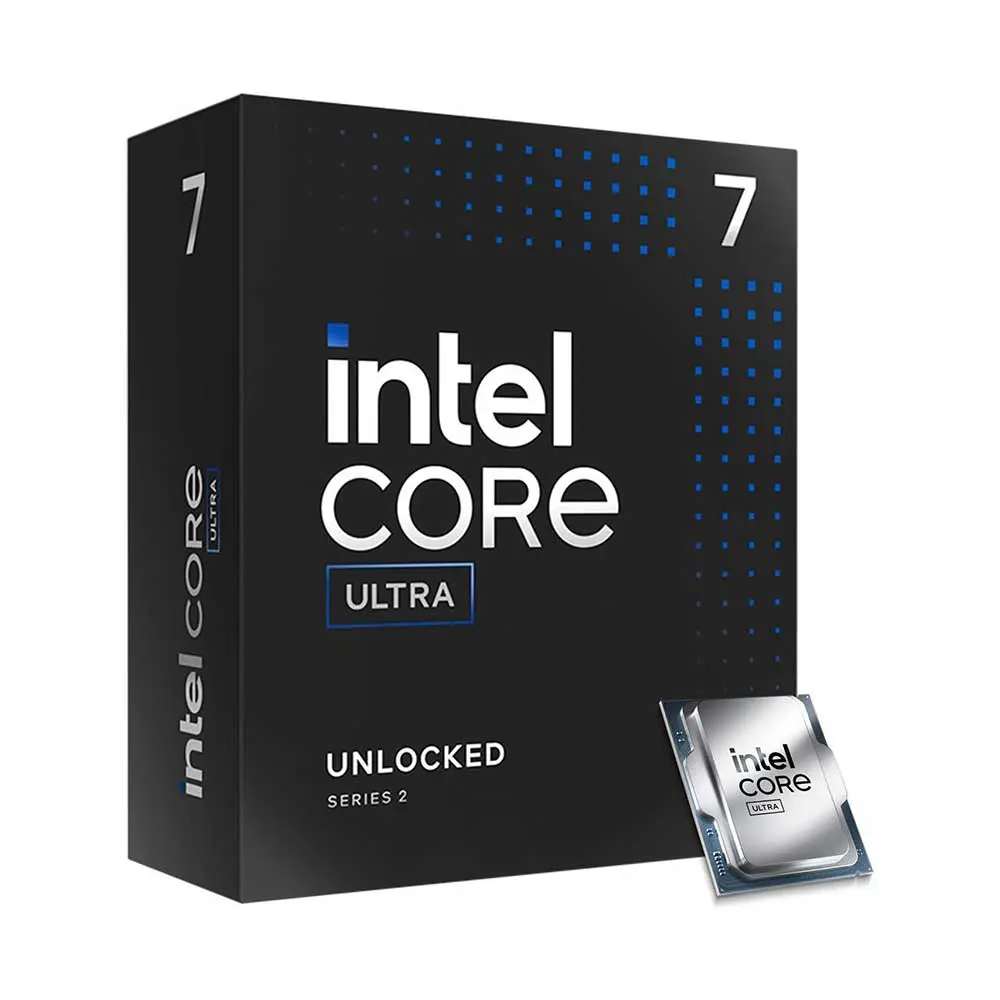
Core Ultra 7 265K (Series 2)
🏗️ The Current Flagship: Core Ultra 7 265K (Series 2)
The Core Ultra 7 265K (Series 2), built on the Arrow Lake architecture, is the current cornerstone for desktop enthusiasts. It marks a major departure from previous generations by removing Hyper-Threading to favor raw physical core efficiency.
| Feature | Specification |
| Architecture | Arrow Lake-S (TSMC 3nm Compute Tile) |
| Cores / Threads | 20 Cores (8 Performance + 12 Efficiency) / 20 Threads |
| Boost Clock | Up to 5.5 GHz |
| NPU (AI Boost) | 13 TOPS |
| Socket | LGA 1851 |
Why it matters: By ditching Hyper-Threading, Intel has managed to keep the processor significantly cooler than the older 13th and 14th Gen i7s while delivering better “per-thread” performance. This makes it a top-tier choice for heavy gaming and high-end productivity without the thermal issues of the past.
⚡ The 2026 Upgrade: Core Ultra 7 270K “Plus”
Just released in early 2026, the Arrow Lake Refresh (the “Plus” series) has pushed the 7-tier even further. The Core Ultra 7 270K Plus is designed for those who need “i9-level” power at a more accessible price point.
- Expanded Cores: It jumps from 20 to 24 cores (8P + 16E), providing a massive boost in multi-threaded tasks like 4K video rendering and 3D modeling.
- Memory Speeds: Native support for DDR5-7200 out of the box, significantly reducing data latency for complex workloads.
- Thermal Efficiency: Despite the higher core count, it maintains a 125W base TDP, making it surprisingly easy to cool with high-end air coolers.
💻 Mobile Evolution: Panther Lake (Series 3)
Launched at CES 2026, the newest mobile-tier processors (Core Ultra 7 358H and similar) are the first to use Intel’s revolutionary 18A process technology.
The AI Revolution: These chips feature a new NPU 5 capable of up to 50 TOPS, meaning they can run complex AI models (like local LLMs or advanced video editing filters) entirely on-device without draining the battery.
- Graphics Leap: The integrated Xe3 “Battlemage” graphics in these processors have reached a point where they can play modern AAA games at 1080p with high settings, often negating the need for a dedicated GPU in thin-and-light laptops.
- Battery Life: Early 2026 benchmarks show Panther Lake-powered laptops routinely hitting 20+ hours of real-world use.
🛠️ Key Considerations for 2026
If you are looking to build or buy a system featuring an Intel 7-tier processor today, here is what you need to know:
- Socket Change: The legacy LGA 1700 socket is retired. Modern Core Ultra 7 desktop chips require the LGA 1851 socket found on Z890 and B860 motherboards.
- DDR5 is Mandatory: These chips have fully phased out DDR4 support. You will need to invest in high-speed DDR5 memory to get the advertised performance.
- AI Readiness: With “AI PCs” becoming the standard, the built-in NPU in the Core Ultra 7 ensures your system will be compatible with next-gen Windows features and creative software for years to can.